LPUNEST is popularly known as
the Lovely Professional University National Entrance and Scholarship
Test, which is a University-level entrance test conducted every year
by the Lovely Professional University, to provide admission to the
undergraduate and postgraduate programs of Engineering,
Management, Arts, Architecture Design and Planning, Commerce and Economics,
etc., offered by
Lovely Professional University.
LPUNEST is a computer-based online
examination, which is conducted in multiple schedules. The exam acts
as a gateway to different programs for students. It
also act as Scholarship test through which student can avail immense
scholarship based on their performance in this LPUNEST exam.
Important dates of the LPUNEST 2021 exam such as application form, admit card, exam, and result are
listed below. Candidates must go through the dates related to the
LPUNEST exam by mentioned below table:
PARTICULAR
DATE
LPUNEST
Registration begins
1st
Week of January 2021
LPUNEST
Registration closes
20th
March 2021
Slot
Booking for online examination
15th
February 2021 onwards
Date
of Examination
20th
March to 5th April 2021
Announcement
of Result
10th
April 2021
LPUNEST
Counselling and Seat Allocation
10th
April 2021 onwards
Rounds and Online Counselling and
Seat Allocation
Counselling
Rounds
Online
Preference Filling
Allotment
Result
Date
of Admission
Round
I
10th
to 13th April 2021
15th
April 2021
15th
to 20th April 2021
Round
II
15th
to 20th April 2021
22nd
April 2021
22nd
to 30th April 2021
For Integrated (BBA + MBA)
After the counselling candidates
need to appear and qualify Interview as per the following schedule
PARTICULAR
DATE
Slot
booking for Interview
15th
April 2021 onwards
Dates
of Interview
18th
April to 5th May 2021
Result
for Interview
Within
48 hours
For All other MBA Programmes
PARTICULAR
DATE
Slot
booking for Interview
10th
to 13th April 2021
Dates
of Interview
14th
to 18th April 2021
Result
for Interview
21st
April 2021
Date
of Admission
21st
April 2021 Onwards
LPUNEST Application Process 2021
LPUNEST Exam
2021 registration process ends on March 20, 2021. Candidates who want
to participate in the exam have to apply for the exam by filling the
application form through the official website of the LPUNEST. It is
both an online and offline process which is given below.
Through Online Mode
Step 1: Registration
Open the official website of
LPNEST 2021 – LPUADMIT.
Get yourself registered and
generate a login id and password by filling in the required details
and email id.
The password will be sent to
your registered email id.
Step 2: Fee Payment
After the process of registration is
done, you have to pay the registration fee through – net banking/
credit card/ debit card.
LPUNEST Exam
Application Fees 2021
Mode
Male
Female
Online
Application Form and Soft copy of LPUNEST Kit
1000
INR
500
INR
Online
Application Form and hard copy of LPUNEST Kit
1500
INR
1000
INR
Step 3: Fill LPUNEST online
application form 2021
Fill in all the required details
asked in the application form of LPUNEST 2021.
Step 4: Uploading Documents
Upload the scanned photograph
(Check the Dimension).
Upload the scanned signature
(Check the Dimension).
Step 5: Final Submission
After completing all the steps
mentioned above candidates will have to do the final submission of
the LPUNEST application form.
Through Offline Mode
Step 1: Buy Application Form
Candidates can obtain LPUNEST Kit
from University Campus/Camp Offices or any other authorized place.
LPUNEST Exam
Application Fees 2021
Mode
Male
Female
Application
Form and Hard copy of LPUNEST Kit
1500
INR
1000
INR
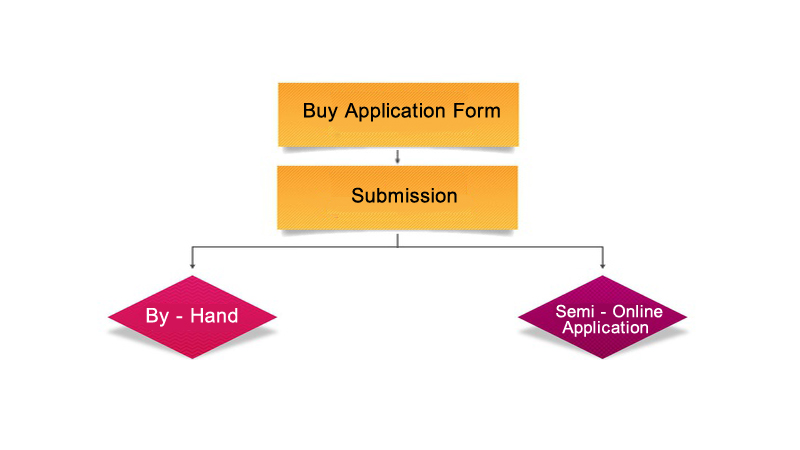
Step 2: Submission
Candidates can submit the
application form by one of the following methods:
By-Hand
Go through the complete
direction as specified under the “Instructions for filling
Application Form (OMR sheet)”
Fill the application form.
Now sent it to the university
in a self-addressed envelope.
Semi-Online
Application
If the candidates do not want to
send the hard copy of the purchased application form:
Fill the registration form
through the official website of LPNEST 2021 – LPUADMIT.
Click the “review details”.
Select “yes” in the field
“Do you have LPUNEST kit”.
At the time of payment enter
the scratch code.
Submit and save a copy of the
complete application form for your reference.
LPUNEST Exam Eligibility 2021
Candidates who want to take
admission in the undergraduate and postgraduate courses in the field
of Engineering, Management, Hotel Management, Pharmacy, Teaching and
Fine Arts course offered by the Lovely Professional University (LPU)
will have to take the common entrance exam conducted by the
university itself. For this students have to be fit the eligibility
criteria of the LPUNEST 2021 issued by the exam conducting authority.
Listed below are the eligibility criteria for the LPUNEST entrance
exam for both the undergraduate and postgraduate courses 2021:
LPUNEST Eligibility criteria for
UG courses
A candidate seeking admission
for the undergraduate courses must have passed class 10+2 or
equivalent in relevant stream from a recognized board or university
with a minimum of 50% aggregate marks.
Relaxation of 5% has been given
to the North-East states and Sikkim candidates/ Defence Personnel
and their Dependents/ Wards of Kashmiri Migrants.
Nationality: Only Indian
Nationals are eligible.
Students in Class 10+2 or
awaiting board results are also eligible to apply for LPUNEST.
LPUNEST Eligibility criteria for
B.Tech, Law courses
A candidate must have passed
class 10+2 or equivalent in relevant stream from a recognized board
or university with a minimum of 60% aggregate marks.
Relaxation of 3% has been given
to the OBC Applicants.
Relaxation of 5% has been given
to the SC/ST, North-East states, and Sikkim candidates/ Defence
Personnel and their Dependents/ Wards of Kashmiri Migrants.
Nationality: Only Indian
Nationals are eligible.
Students in Class 10+2 or
awaiting board results are also eligible to apply for LPUNEST.
LPUNEST Eligibility criteria for
PG courses
Candidate should passed
Bachelor’s Degree or equivalent in relevant subject from a
recognized university with a minimum of 60% aggregate marks.
Final year graduation students
or those awaiting final results are also eligible to apply.
Relaxation of 5% has been given
to the North-East states and Sikkim candidates/ Defence Personnel
and their Dependents/ Wards of Kashmiri Migrants.
Nationality: Only Indian
Nationals are eligible.
LPUNEST Eligibility criteria for
M.Tech courses
Candidate should passed
B.E./B.Tech or equivalent in relevant subject from a recognized
university with a minimum of 60% aggregate marks.
Final year graduation students
or those awaiting final results are also eligible to apply.
Relaxation of 5% has been given
to the North-East states and Sikkim candidates/ Defence Personnel
and their Dependents/ Wards of Kashmiri Migrants.
Nationality: Only Indian
Nationals are eligible.
LPUNEST Eligibility criteria for
MBA courses
Candidate should passed
Bachelor’s Degree or equivalent in relevant subject from a
recognized university OR Completed Company Secretary (CS) from
Institute of Company Secretaries of India (ICSI) or Completed
Chartered Accountancy (CA) from Institute of Chartered Accountants
of India (ICAI) or Completed Cost & Management Accountancy (CMA)
from the Institute of Cost Accountants of India (ICAI) with a minimum of
55% aggregate marks.
Final year graduation students
or those awaiting final results are also eligible to apply.
Relaxation of 5% has been given
to the North-East states and Sikkim candidates/ Defence Personnel
and their Dependents/ Wards of Kashmiri Migrants.
Nationality: Only Indian
Nationals are eligible.
LPUNEST Exam Pattern 2021
Diploma
For Courses: Diploma in
Engineering, Diploma in Engineering (Lateral Entry), Diploma in
Architectural Assistantship, Diploma in Architectural Assistantship
[Lateral Entry], Diploma in Business Administration, Diploma in
Medical Lab. Technology (DMLT), Diploma - B.Tech (Dual Programme)
Duration: 90 minutes (1
hour 30 minutes)
Exam Pattern: Objective
type multiple-choice questions (MCQs)
Exam Mode: Online
No marks will be deducted for
any wrong or unattempted question
Subjects
No.
of Questions
Marks
Per Question
Maximum
Marks Per Subject
English
30
Questions
1
Mark
30
Marks
Mathematics
15
Questions
2
Marks
30
Marks
Reasoning
Aptitude
15
Questions
2
Marks
30
Marks
General
Knowledge
30
Questions
1
Mark
30
Marks
Science
15
Questions
2
Marks
30
Marks
B.Tech
Duration: 150 minutes (2
hours 30 minutes)
Exam Pattern: Objective
type multiple-choice questions (MCQs)
Exam Mode: Online
No marks will be deducted for
any wrong or unattempted question
Subjects
No.
of Questions
Marks
Per Question
Maximum
Marks Per Subject
Physics
30
questions
4
Marks
120
Marks
Chemistry
30
questions
4
Marks
120
Marks
Mathematics
30
questions
4
Marks
120
Marks
Biology
30
questions
4
Marks
120
Marks
UG Business, Journalism, Education & Computer
Applications
For Courses: BA
(Journalism and Mass Communication), B.Com, B.Com (Hons.), B.Com
(Management Accounting and International Finance) with IMA, USA,
B.Sc (Computer Science), B.Sc (Hons.) Economics, B.Sc (Information
Technology), BBA, BBA (Financial Markets) with NSE Academy, BBA
(Hons.), BBA (Information Technology), BBA (International Finance)
with IMA, USA, BCA, BCA (Hons.), Integrated B.A. - B.Ed., Integrated
B.Sc. - B.Ed., Integrated BBA - MBA
Duration: 90 minutes (1
hour 30 minutes)
Exam Pattern: Objective
type multiple-choice questions (MCQs)
Exam Mode: Online
No marks will be deducted for
any wrong or unattempted question
English is Compulsory and the
applicant can opt for any two of the remaining Subjects
Subjects
No.
of Questions
Marks
Per Question
Maximum
Marks Per Subject
English
30
Questions
1
Mark
30
Marks
Physics
15
Questions
2
Marks
30
Marks
Chemistry
20
Questions
1.5
Marks
30
Marks
Mathematics
15
Questions
2
Marks
30
Marks
Biology
20 Questions
1.5
Marks
30
Marks
Accountancy
20
Questions
1.5
Marks
30
Marks
Business
Studies
20
Questions
1.5
Marks
30
Marks
Economics
20
Questions
1.5
Marks
30
Marks
Computer
Science
20
Questions
1.5
Marks
30
Marks
History
30
Questions
1
Mark
30
Marks
Sociology
30
Questions
1
Mark
30
Marks
Psychology
30
Questions
1
Mark
30
Marks
Geography
30
Questions
1
Mark
30
Marks
Agriculture
30
Questions
1
Mark
30
Marks
Physical
Education
30
Questions
1
Mark
30
Marks
Political
Science
30
Questions
1
Mark
30
Marks
Public
Administration
30
Question
1
Mark
30
Marks
General
Aptitude
15
Question
2
Mark
30
Marks
General
Awareness
30
Question
1
Mark
30
Marks
Under Graduate – Regular
For Courses: B.Arch, BA
(Fine Arts), BA (Hons.), BA (Music Vocal), BA (Theatre), B.Plan,
B.Sc. (Health and Physical Education), BA, BFA, B.P.Ed.S, BPA (Music
Vocal), BPA (Theatre), Diploma in Library and Information Sciences
Duration: 90 minutes (1
hour 30 minutes)
Exam Pattern: Objective
type multiple-choice questions (MCQs)
Exam Mode: Online
No marks will be deducted for
any wrong or unattempted question
English is Compulsory and the
applicant can opt for any two of the remaining Subjects
Subjects
No.
of Questions
Marks
Per Question
Maximum
Marks Per Subject
English
30
Questions
1
Mark
30
Marks
Physics
15
Questions
2
Marks
30
Marks
Chemistry
20
Questions
1.5
Marks
30
Marks
Mathematics
15
Questions
2
Marks
30
Marks
Biology
20
Questions
1.5
Marks
30
Marks
Accountancy
20
Questions
1.5
Marks
30
Marks
Business
Studies
20
Questions
1.5
Marks
30
Marks
Economics
20
Questions
1.5
Marks
30
Marks
Computer
Science
20
Questions
1.5
Marks
30
Marks
History
30
Questions
1
Mark
30
Marks
Sociology
30
Questions
1
Mark
30
Marks
Psychology
30
Questions
1
Mark
30
Marks
Geography
30
Questions
1
Mark
30
Marks
Agriculture
30
Questions
1
Mark
30
Marks
Physical
Education
30
Questions
1
Mark
30
Marks
Political
Science
30
Questions
1
Mark
30
Marks
Public
Administration
30
Question
1
Mark
30
Marks
General
Aptitude
15
Question
2
Mark
30
Marks
General
Awareness
30
Question
1
Mark
30
Marks
UG Hotel Management
For Courses: B.Sc
(Airlines, Tourism and Hospitality), B.Sc (Hotel Management),
Bachelor of Hotel Mgt. and Catering Technology, BBA (Airlines and
Airport management), BBA (Tourism and Hospitality)
Duration: 150 minutes (2
hours 30 minutes)
Exam Pattern: Objective
type multiple-choice questions (MCQs)
Exam Mode: Online
No.of Questions: 100
No marks will be deducted for
any wrong or unattempted question
Subjects
No.
of Questions
Marks
Per Question
Maximum
Marks Per Subject
English
30
questions
2
Marks
60
Marks
Service
Aptitude
15
questions
2
Marks
30
Marks
General
Awareness
25
questions
2
Marks
50
Marks
Quantitative
Aptitude
15
questions
2
Marks
30
Marks
Reasoning
and Logical Ability
15
questions
2
Marks
30
Marks
UG – LAW
For Courses: BA
LL.B.(Hons.), BBA LL.B. (Hons.)
Duration: 120 minutes (2
hours)
Exam Pattern: Objective
type multiple-choice questions (MCQs)
Exam Mode: Online
No.of Questions: 80
No marks will be deducted for
any wrong or unattempted question
Subjects
No.
of Questions
Marks
Per Question
Maximum
Marks Per Subject
English
20
questions
2.5
Marks
50
Marks
Quantitative
and Logical Aptitude
20
questions
2.5
Marks
50
Marks
Legal
Reasoning
20
questions
2.5
Marks
50
Marks
General
Awareness
20
questions
2.5
Marks
50
Marks
LL.B.
Duration: 120 minutes (2
hours)
Exam Pattern: Objective
type multiple-choice questions (MCQs)
Exam Mode: Online
No.of Questions: 80
No marks will be deducted for
any wrong or unattempted question
Subjects
No.
of Questions
Marks
Per Question
Maximum
Marks Per Subject
English
20
questions
2.5
Marks
50
Marks
Quantitative
and Logical Aptitude
20
questions
2.5
Marks
50
Marks
Legal
Reasoning
20
questions
2.5
Marks
50
Marks
General
Awareness
20
questions
2.5
Marks
50
Marks
UG Design
For Courses: B.Design
(Fashion), B.Design (Film and TV Production ), B.Design (Gaming),
B.Design (Graphics), B.Design (Interior & Furniture), B.Design
(Multimedia), B.Design (Product and Industrial), B.Sc. (Design -
Fashion), B.Sc. (Design - Gaming ), B.Sc. (Design - Graphics), B.Sc.
(Design - Interior and Furniture), B.Sc. (Design - Multimedia) B.Sc.
(Film and TV Production)
Duration: 150 minutes (2
hours 30 minutes)
Exam Pattern: Objective
type multiple-choice questions (MCQs)
Exam Mode: Online
No.of Questions: 100
No marks will be deducted for
any wrong or unattempted question
Exam Pattern: Objective
type multiple-choice questions (MCQs)
Exam Mode: Online
No marks will be deducted for
any wrong or unattempted question
English is Compulsory and the
applicant can opt for any of the following combinations, i.e.,
Physics, Chemistry, Mathematics or Physics, Chemistry, Biology or
Crop Production, Horticulture.
Subjects
No.
of Questions
Marks
Per Question
Maximum
Marks Per Subject
English
30
Questions
2
Marks
60
Marks
Physics
30
Questions
4
Marks
120
Marks
Chemistry
30
Questions
4
Marks
120
Marks
Mathematics
30
Questions
4
Marks
120
Marks
Biology
30
Questions
4
Marks
120
Marks
Horticulture
30
Questions
4
Marks
120
Marks
Crop
Production
60
Questions
4
Marks
240
Marks
Lateral Entry Courses (LET)
Duration: 90 minutes (1
hour 30 minutes)
Exam Pattern: Objective
type multiple-choice questions (MCQs)
Exam Mode: Online
No marks will be deducted for
any wrong or unattempted question
English is Compulsory and the
applicant can opt for any two of the remaining Subjects
Subjects
No.
of Questions
Marks
Per Question
Maximum
Marks Per Subject
English
30
Questions
1
Mark
30
Mark
Mathematics
15
Questions
2
Marks
30
Mark
Information
Technology
20
Questions
1.5
Marks
30
Mark
General
Awareness
30
Questions
1
Mark
30
Mark
Reasoning
Aptitude
15
Questions
2
Marks
30
Mark
General
Engineering
20
Questions
1.5
Marks
30
Mark
Science
15
Questions
2
Marks
30
Mark
Service
Aptitude
15
Questions
2
Marks
30
Mark
Design
Thinking
15
Questions
2
Marks
30
Mark
Pharmacy
30
Questions
1
Mark
30
Mark
Ayurveda
30
Questions
1
Mark
30
Mark
Medical
Laboratory Sciences
30
Questions
1
Mark
30
Mark
B.Ed.
Duration: 90 minutes (1
hour 30 minutes)
Exam Pattern: Objective
type multiple-choice questions (MCQs)
Exam Mode: Online
No.of Questions: 75
No marks will be deducted for
any wrong or unattempted question
Subjects
No.
of Questions
Marks
Per Question
Maximum
Marks Per Subject
Language
Proficiency
30
questions
1
Marks
30
Marks
Reasoning
Ability
15
questions
2
Marks
30
Marks
Teaching
Aptitude
30
questions
1
Marks
30
Marks
MBA
Duration: 150 minutes (2
hours 30 minutes)
Exam Pattern: Objective
type multiple-choice questions (MCQs)
Exam Mode: Online
No.of Questions: 100
No marks will be deducted for
any wrong or unattempted question
Subjects
No.
of Questions
Marks
Per Question
Maximum
Marks Per Subject
English
40
questions
3
Marks
120
Marks
General
Awareness
20
questions
3
Marks
60
Marks
General
Aptitude
40
questions
3
Marks
120
Marks
M.Tech
Duration: 90 minutes (1
hour 30 minutes)
Exam Pattern: Objective
type multiple-choice questions (MCQs)
Exam Mode: Online
No marks will be deducted for
any wrong or unattempted question
English is Compulsory and the
applicant can opt for any one of the remaining Subjects
Subjects
No.
of Questions
Marks
Per Question
Maximum
Marks Per Subject
English
30
Questions
1
Mark
30
Mark
Computer
Science
40
Questions
1.5
Marks
60
Mark
Electronics
40
Questions
1.5
Marks
60
Mark
Mechanical
Engineering
40
Questions
1.5
Marks
60
Mark
Biotechnology
40
Questions
1.5
Marks
60
Mark
Civil
Engineering
40
Questions
1.5
Marks
60
Mark
Electrical
Engineering
40
Questions
1.5
Marks
60
Mark
Food
Technology
40
Questions
1.5
Marks
60
Mark
PG Sciences
For Courses: For all
M.Sc, M.Pharma, and MPT courses offered by LPU.
Duration: 90 minutes (1
hour 30 minutes)
Exam Pattern: Objective
type multiple-choice questions (MCQs)
Exam Mode: Online
No marks will be deducted for
any wrong or unattempted question
English is Compulsory and the
applicant can opt for any one of the remaining Subjects
For Courses: M.A.
(Journalism and Mass Communication), M.Com., M.Sc. (Computer
Science), M.Sc. (Film and TV Production), M.Sc. (Hons.) Economics,
M.Sc. (Information Technology), MCA, MCA (Hons.).
Duration: 90 minutes (1
hour 30 minutes)
Exam Pattern: Objective
type multiple-choice questions (MCQs)
Exam Mode: Online
No marks will be deducted for
any wrong or unattempted question
English is Compulsory and the
applicant can opt for any one of the remaining Subjects
Subjects
No.
of Questions
Marks
Per Question
Maximum
Marks Per Subject
English
30
Questions
1
Mark
30
Mark
Commerce
40
Questions
1.5
Mark
60
Mark
Economics
40
Questions
1.5
Mark
60
Mark
General
Aptitude
30
Questions
2
Mark
60
Mark
General
Awareness
60
Questions
1
Mark
60
Mark
Journalism
& Film Production
40
Questions
1.5
Mark
60
Mark
Computer
Science
40
Questions
1.5
Mark
60
Mark
Computer
Application
30
Questions
2
Mark
60
Mark
Mathematics
30
Questions
2
Mark
60
Mark
PG – Regular
For Courses: B.P.Ed., B.
Lib. I.Sc., M.A. (Clinical Psychology), M.A. (Education), M.A.
(English), M.A. (Hindi), M.A. (History), M.A. (Music Vocal), M.A.
(Political Science), M.A. (Psychology), M.A. (Public
Administration), M.A. (Punjabi), M.A. (Sociology), M.P.Ed., M.Sc.
(Geography), M.Sc. (Hotel Management), MFA, M. Lib. I.Sc.
Duration: 90 minutes (1
hour 30 minutes)
Exam Pattern: Objective
type multiple-choice questions (MCQs)
Exam Mode: Online
No marks will be deducted for
any wrong or unattempted question
English is Compulsory and the
applicant can opt for any one of the remaining Subjects
Subjects
No.
of Questions
Marks
Per Question
Maximum
Marks Per Subject
English
30
Questions
1
Marks
30
Marks
General
Aptitude
30
Questions
2
Marks
60
Marks
General
Awareness
60
Questions
1
Marks
60
Marks
English
(Literature)
40
Questions
1.5
Marks
60
Marks
Punjabi
(Literature)
40
Questions
1.5
Marks
60
Marks
Music
40
Questions
1.5
Marks
60
Marks
Psychology
40
Questions
1.5
Marks
60
Marks
Physical
Education
40
Questions
1.5
Marks
60
Marks
Sociology
40
Questions
1.5
Marks
60
Marks
History
40
Questions
1.5
Marks
60
Marks
Political
Science
40
Questions
1.5
Marks
60
Marks
Public
Administration
40
Questions
1.5
Marks
60
Marks
Geography
40
Questions
1.5
Marks
60
Marks
Education
40
Questions
1.5
Marks
60
Marks
Hotel
Management
40
Questions
1.5
Marks
60
Marks
Commerce
40
Questions
1.5
Marks
60
Marks
Economics
40
Questions
1.5
Marks
60
Marks
Fine
Arts
40
Questions
1.5
Marks
60
Marks
LL.M.
Duration: 120 minutes (2
hours)
Exam Pattern: Objective
type multiple-choice questions (MCQs)
Exam Mode: Online
No.of Questions: 160
No marks will be deducted for
any wrong or unattempted question
Subjects
No.
of Questions
Marks
Per Question
Maximum
Marks Per Subject
English
40
questions
1
Mark
40
Marks
Constitutional
Law
40
questions
1
Mark
40
Marks
Jurisprudence
40
questions
1
Mark
40
Marks
Other
Law subjects
40
questions
1
Mark
40
Marks
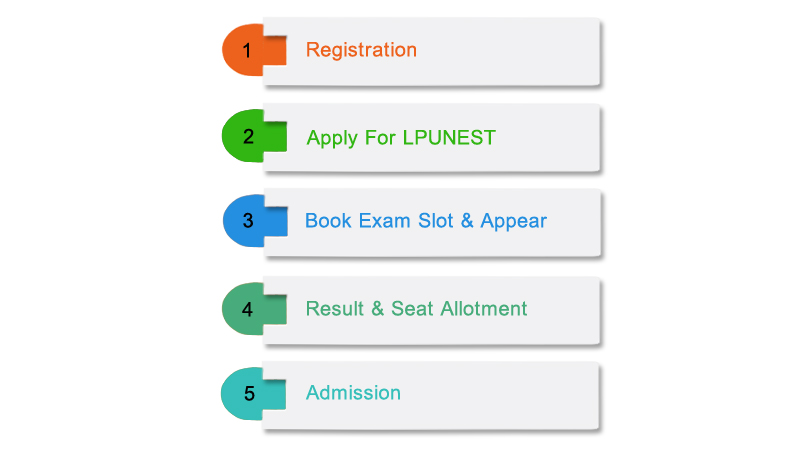
LPUNEST Admission Process 2021
Step 1: Registration
Get yourself registered for the
LPUNEST exam 2021 by filling in the required details through the
official website of LPUADMIT.
Step 2: Apply for LPUNEST
After registration students must
have to apply for the LPUNEST exam to get admitted in the desired
program and also to get the scholarship.
Step 3: Slot Booking and Exam
Candidates must have to book
the exam slot to appear in the LPUNEST.
This test would be conducted in
more than 190 cities pan India.
Download the hall ticket.
Appear and qualify for the
exam.
Step 4: Result and Seat Allotment
Get result.
Fill the seat according to the
preference.
Depending upon the seat
availability and preferences filled by the candidates, a particular
preference number would be allotted in the first round of
counselling.
Download the allotment letter.
Step 5: Admission
Deposit initial fee of 20000
INR.
After the successful fee
payment a “Unique Provisional Registration No.” will be
generated and sent to your registered Email ID.
Upload the documents which is
required:
Recent Photograph
Matriculation Marksheet
Qualifying exam
Certificate/Marksheet
Address Proof
Final year students can submit
the Certificate/Marksheet, later.
Apply for a
residential/mess/transportation/parking facility as per the
requirement.
All the documents have to be
verified from the originals within the prescribed timelines.
Within the timelines prescribed
by the university deposit the balance fee.
Note:
Subsequent rounds of counselling may follow depending upon the
availability of seats.
LPUNEST Syllabus 2021
LPUNEST is a university level
entrance exam conducted every year to provide admission and
scholarships in the different undergraduate and postgraduate courses
offered by the Lovely Professional University (LPU). There are
different syllabus for different courses offered by the LPUNEST exam.
Mathematics Syllabus for Diploma and Lateral
Entry Courses
Mathematics
Real
numbers
Polynomials
Pair
of linear equations in two variables
Triangles
Introduction
to trigonometry
Statistics
Quadratic
equations
Arithmetic
Progressions
Circles
Trigonometrical
Identities
Heights
and distances
Probability
Lines
Areas
related to circles
Surface
areas and volumes
Science Syllabus for Diploma and Lateral Entry
Courses
Science
Reflection
Refraction
Effects
of current
Magnetic
effects of current
Sources
of energy
Chemical
reactions
Acids,
bases, and salts
Metals
and non-metals
Carbon
compounds
Periodic
classification of elements
Life
processes
Reproduction
Heredity
and evolution
Conservation
of natural resources
The
Regional environment and our environment
English Syllabus for Diploma Courses
Section
Topics
Parts
of speech
Nouns
Pronouns
Verbs
Adjectives
Adverb
Prepositions
Conjunctions
Articles
and Interjections
Tenses
Present
Past
Future
Modal
Verbs
Determiners
and Quantifiers
Vocabulary
Antonyms
Synonyms
Confused
Words
Phrasal
Verbs
Sentence
Correction Sentence Completion
Active
Passive Voice
Direct
Speech
Clauses
Noun
Clause
Adverb
Clause
Relative
Clause
Subject-Verb
Agreement
Conditionals
Zero
First, Second, and Third Short Unseen Passages With MCQs
Spellings
Idioms
Proverbs
Reasoning Aptitude Syllabus for Diploma and
Lateral Entry Courses
Reasoning
Aptitude
Numbers
Percentage
Profit,
Loss & Discount
Ratio
& Proportion
Simple
& Compound Interest
Permutation
& Combination & Probability
Time
& Distance
Boats
& streams
Races
& Games
Time
& Work
Pipes
& Cistern
Calendar
& Clocks
Area
Series
completion & Coding-Decoding & Alphabet test
Direction
sense test & Blood relations & arrangements
Syllogism
Number
Ranking
& Time sequence test
Arithmetical
reasoning
Inserting
the missing character
Data
sufficiency
Cubes
and dice
Non-verbal
reasoning
General Knowledge Syllabus for Diploma Courses
Section
Topics
Current
Affairs
Sports
Economy
International
Science
& Technology
Politics
Fashion
Social
Science
Democratic
Politics
Contemporary
India
India
and the Contemporary World
Economics
Sports
Cricket
Football
Tennis
Olympic
science
World
of Living
Chemical
Substances-Nature and Behaviour
Natural
Phenomena
Effects
of Current
Natural
Resources
Information
Technology
Basics
of Information Technology
Office
Tools
Chemistry Syllabus for all Undergraduate Courses
Unit
No.
Section
Topics
Unit
1
Atomic
Structure, States of Matter & Thermodynamics
Some
basic concepts in chemistry
States
of matter
Gaseous
State
Liquid
State
Solid
State
Atomic
structure
Chemical
bonding and molecular structure
Covalent
Bonding
Quantum
mechanical approach to covalent bonding
Molecular
Orbital Theory
Chemical
thermodynamics
First
law of thermodynamics
Second
law of thermodynamics
Unit
2
Solutions,
Chemical Kinetics & Surface Chemistry
Solutions
Equilibrium
Equilibria
involving physical processes
Equilibria
involving chemical processes
Ionic
equilibrium
Redox
reactions and Electrochemistry
Electrochemical
cells
Chemical
Kinetics
Surface
chemistry
Colloidal
State
Unit
3
Hydrogen
& s - Block Element
Classification
of elements and periodicity in properties
General
principles and processes of isolation of metals
Hydrogen
s
- Block elements (alkali and alkaline earth metals) Group - 1 and
2 Elements
Unit
4
p,
d & f Block Elements and Environmental Chemistry
p
- Block elements
d
– and f – Block elements
Inner
Transition Elements
Coordination
Compounds
Environmental
chemistry
Tropospheric
pollutants – Gaseous pollutants
Stratospheric
pollution
Unit
5
Basic
Concepts of Organic Chemistry
Purification
and characterization of organic compounds: Purification
Qualitative
analysis
Quantitative
analysis (Basic Principles only)
Some
basic principles of organic chemistry
Nomenclature
(Trivial and IUPAC) Covalent bond fission
Electronic
displacement in a covalent bond
Common
types of organic reactions
Alkanes
Alkenes
Alkynes
Aromatic
hydrocarbons
Organic
compounds containing halogens
Unit
6
Oxygen,
Nitrogen, Polymers & Biomolecules
Practical
Chemistry
Nucleic
acids
Chemistry
in everyday life
Chemicals
in food
Cleansing
agents
Organic
compounds containing Oxygen
Alcohols
Phenols
Ethers
Aldehyde
and Ketones
Carboxylic
acids
Organic
compounds containing Nitrogen
Amines
Diazonium
Salts
Polymers
Biomolecules
Carbohydrates
Proteins
Vitamins
Chemistry
in everyday life
Cleansing
agents
Chemicals
in food
Nucleic
acids
Physics Syllabus for all Undergraduate Courses
Unit
No.
Section
Topics
Unit
1
Motion
Laws
of motion
Rotational
motion
Work,
energy, and power
Unit
2
Kinematics,
Gravitation & Oscillations
Physics
and measurement
Oscillations
and waves
Gravitation
Kinematics
Unit
3
Thermal
Physics
Properties
of solids and liquids
Thermodynamics
Kinetic
theory of gases
Unit
4
Electricity
& Magnetism
Electrostatics
Current
electricity
Magnetic
effects of current and magnetism
Unit
5
Atomic
Structure & Optics
Wave
optics
Dual
nature of matter and radiation
Optics
Atoms
and nuclei
Unit
6
Electrical
& Electronics
Electromagnetic
induction and alternating currents
Electronic
devices
Electromagnetic
waves
Mathematics Syllabus for all Undergraduate
Courses
Unit
No.
Section
Topics
Unit
1
Algebra
Sets,
relations, and functions
Sequences
and series
Complex
numbers and quadratic equations
Unit
2
Matrices,
Vectors & Reasoning
Matrices
& Determinants
Vector
algebra
Mathematical
reasoning
Unit
3
Permutation-Combinations
& Binomial Theorem
Permutations
and Combinations
Binomial
theorem and its simple applications
Mathematical
induction
Unit
4
Limit,
Integration & Differentiation
Limit,
continuity, and differentiability
Integral
calculus
Unit
5
Geometry
Coordinate
geometry
Three
Dimensional Geometry
Circles,
conic sections
Straight
lines
Unit
6
Probability
& Trigonometry
Trigonometry
Probability
Statistics
and probability
Biology Syllabus for all Undergraduate Courses
Unit
No.
Section
Topics
Unit
1
Diversity
& Structural Organisation
Five
kingdom classification
Structural
Organisation in Animals and Plants
Cell
Structure and Function
Cell
division
Unit
2
Plant
Physiology
Transport
in plants
Mineral
nutrition
Photosynthesis
Respiration
Plant
growth and development
Unit
3
Human
Physiology
Chemical
coordination and regulation
Breathing
and Respiration
Body
fluids and circulation
Excretory
Products and their elimination
Locomotion
and Movement
Neural
control and coordination
Digestion
and absorption
Unit
4
Reproduction,
Genetics and Evolution
Evolution
Sexual
reproduction in flowering plants
Human
Reproduction
Reproductive
health
Genetics
and Evolution
Molecular
Basis of Inheritance
Reproduction
in organisms
Unit
5
Biology,
Biotechnology and Human Welfare
Health
and Disease
Improvement
in food production
Microbes
in human welfare
Application
of Biotechnology in health and agriculture
Biotechnology
and Its Applications
Unit
6
Ecology
and environment
Environmental
issues
Ecosystem
Biodiversity
and its conservation
Organisms
and environment
English/Communication Ability/Language
Proficiency Syllabus for all UG, PG, B.Ed. & Lateral Entry
Courses
Section
Topics
Grammar
Parts
of speech– Noun, Pronoun, Adjective, Adverb, Verb,
Preposition, Conjunction Interjection
Tenses
– Present, Past and Future Tense in Active and Passive Form
Modal
Verbs – Can, Could, May, Might, Should, Will, Would
Associative
Language Skills
Vocabulary
– Antonyms, Synonyms, One-word substitution, Word Analogies,
Idioms and Phrases
Common
Errors
Sentence
Correction and Error Finding Exercises
Comprehension
Passages
Closed
and Open paragraphs
identifying
key ideas or theme
Accountancy Syllabus for all Undergraduate
Courses
Accountancy
Introduction
to Accounting
Theory
Base of Accounting
Generation
of Vouchers and Recording of Transactions
Trial
Balance and Rectification of Errors
Depreciation,
Provisions, and Reserves
Bills
of Exchange
Financial
Statements
Financial
Statement of Not-for-Profit Organization
Computers
in Accounting
Accounting
for Partnership
Reconstitution
of Partnership
Dissolution
of Partnership Firm
Accounting
for Share Capital
Accounting
for Debentures
Analysis
of Financial Statement
Cash
flow Statement
Computerized
Accounting
Overview
of Computerized Accounting System
Agriculture Syllabus for all Undergraduate
Courses
Area and production of various
agricultural products and current status
Irrigation and drainage, weed
management
Soil as a growth medium:
Essential elements, organic manures, chemical fertilizers, and
bio-fertilizers
Reclamation of alkaline and
saline soils erosion: causes and remedial measures
Soil, soil pH, soil texture,
soil structure, soil organisms, soil tilth, soil fertility, and soil
health
Organic manure, common
fertilizers including straight, complex, fertilizer mixtures and
biofertilizers, integrated nutrient management system
Livestock farming, Role of
livestock and poultry in agriculture
Breeds of dairy animals and
poultry
Commercial dairy farming and
poultry production
Management of newly born calf,
pregnant and milch animals
Artificial insemination,
pregnancy diagnosis, and detection of heart disease in dairy animals
Crossbreeding
Dairy animal and poultry
diseases: foot and mouth, H.S., mastitis, black quarter, rani kheit
and bird flu
Common feeds of dairy animals
and importance of meat and egg in human foods
Business Studies Syllabus for all Undergraduate
Courses
Section
Topics
Nature
and significance of Management
Types
of management
Administration
Functions
Principles
of Management
Functions
of Management
Planning
Organizing
Staffing
- Selection
Recruitment
Training
and Development
Controlling
Directing
Motivating
- Theories and Types
Business
Environment
Social
Economic
Cultural
and legal environment
Economic
Environment in India
Authority
and responsibility
Delegation
Centralization
Decentralization
Leadership
Theories
and style of leadership
Communication
Introduction
and Types
Barrier
in communication
Financial
Management
Sources
of funds
Capital
Structure
Financial
Markets
Marketing
Management
Types
of goods
Purchase
behaviour
Marketing
communication
Advertising
4
P’s of marketing
Consumer
Protection
Ways
and means
Importance
for business
Consumer
Protection Act
Computer Science Syllabus for all Undergraduate
Courses
Computer
Science
Transmission
Media and Network devices
Evolution
of Networking and Data Communication terminologies
Network
Topologies
Network
Protocols
Network
Security Concepts
Web
terminology
Object-Oriented
Concepts
Constructor
and Destructor
Data
File Handling and Pointers
Introduction
to Data Structures and One Dimensional Arrays
Two
Dimensional Arrays
Stack
Queue
Database
Concepts
Structured
Query Language
SQL
Commands and Functions
Evolution
of Boolean Algebra, Constants and Operators
Laws
of Boolean Algebra
Boolean
Expressions and Basic Logic Gates
Economics Syllabus for all Undergraduate Courses
Section
Topics
Microeconomics
Utility
Analysis
Demand
& Supply Analysis
Market
Equilibrium
Theory
of Cost and Revenue
Various
type of Market structures - Perfect Competition
Monopoly
Monopolistic
Competition
Oligopoly
Macroeconomics
Concepts
of National Income
Structure
and System of Economy
Keynesian
Concepts and Principles of Economics
Monetary
and Fiscal policies
Types
of Business Cycle
Basics
of Money and Banking
Indian
Economy
Recent
developments and trends in GDP
Vital
rates like CRR, Bank rate etc.
Fiscal
deficit, Primary deficit and other types of deficits Inflation
Geography Syllabus for all Undergraduate Courses
Geography
Geography
as a Discipline
The
Earth
Landforms
Climate
Hydrosphere
Hazards
and Disasters: Causes, Consequences and Management
Human
Activities
Introduction
to India
Physiography of
India
Climate
of India
Vegetation
of India
Soils
of India
People of
India
Human
settlements
Land
and agricultural Resources of India
Mineral
and energy resources of India
Industries
of India
Planning
in India
Transport,
Communication in India
International
Trade of India
Geographical
Perspective on selected issues and problems
Fundamentals
of Maps
Topographic
and Weather Maps
Aerial
Photographs
Satellite
imageries
History Syllabus for all Undergraduate Courses
Early Societies, Empires,
Changing Traditions, Towards Modernisation, Bricks, Beads and Bones,
The Harappan Civilisation, Kings, Farmers and Towns, Early States
and Economies (c.600 BCE-600 CE), Kinship, Caste and Class - Early
Societies (600 BCE-600 CE)
Thinkers, Beliefs and Buildings
Cultural Developments (600 BCE- 600 CE)
Through The Eyes Of Travellers:
Perceptions of Society (tenth to seventeenth centuries)
Bhakti – Sufi Traditions:
Changes in Religious Beliefs and Devotional Texts (eighth to
eighteenth centuries
An Imperial Capital:
Vijayanagara (fourteenth to sixteenth centuries)
Peasants, Zamindars and The
State: Agrarian Society and the Mughal Empire (sixteenth-seventeenth
centuries)
Kings and Chronicles: The
Mughal Courts (c. sixteenth-seventeenth centuries)
Colonialism and The
Countryside: Exploring Official Archives
Rebels and The Raj, 1857 Revolt
and its Representations
Mahatma Gandhi and The
Nationalist Movement: Civil Disobedience and Beyond
Framing the Constitution: The
Beginning of a New Era
New India: Nation Building,
World War
Cold war
USSR disintegration
UNO
Physical Education Syllabus for all Undergraduate
Courses
Physical
Education
Changing
Trends in Physical Education
Career
in Physical Education
Physical
Fitness, Wellness & Lifestyle
Yoga
Asanas
Physical
Activity Environment
Health
Fitness
Fundamentals
of Anatomy & Physiology
Fundamentals
of Psychology & Sports
Learning
and its laws
Training
in Sports
Sports
& Nutrition
Postures
Women
& Sports
Physiology
& Sports
Sports
Medicine
Soft
Tissue Injuries
Bone
& Joint Injuries
Psychology Syllabus for all Undergraduate Courses
Section
Topics
Introduction
What
is Psychology?
Understanding
Mind and Behavior
Popular
Notions about the Discipline of Psychology
Evolution
of Psychology
Development
of Psychology in India
Branches
of Psychology
Themes
of Research and Applications
Psychology
and Other Disciplines
Psychologists
at Work
Psychology
in Everyday Life
Methods
of Psychology
Goals
of Psychological Enquiry, Steps in Conducting Scientific
Research, Alternative Paradigms of Research, Nature of
Psychological Data, Some Important Methods in Psychology and
Ethical Issues
Biological
bases of behavior, Structure and Functions of Nervous System
Heredity
Genes
and Behavior, Socio-Cultural Shaping of Behavior, Concept of
Culture
Life
span development, Sensations, Perception, Learning and
applications of Learning Principles
Memory,
Forgetting, Thinking, Problem solving, Thought and Language,
Communication, Motivation, Maslow’s Hierarchy of Needs,
Emotions
Facets
of development
Intelligence
Personality
Psychological
Disorders
Therapeutic
approaches
Introduction
to creativity
Nature,
Types and Sources of Stress
Attitude
Psychology
and life
Human
Influence on the Environment
Counselling
Social
influence and group process
Various
Schools of psychology
Social
cognition
Self
and Personality.
Sociology Syllabus for all Undergraduate Courses
Basics concepts of society and
Sociology, Understanding Social institutions, Culture and
Socialisation process, Indian society: Demographic and structural
realities, Patterns of social inequality and exclusion,
Social change and continuity.
Social Stratification: Caste,
class and gender
Contemporary Social Issues:
Poverty, unemployment and over-population
Political Science Syllabus for all Undergraduate
Courses
Political
Science
Politics
in India since Independence
Constitution
of India
The
structure and functioning of the Indian government
International
and Regional Organizations
Cold
War Era, The End of Bipolarity and U.S hegemony in World affairs
Globalization
Public Administration Syllabus for all
Undergraduate Courses
Public
Administration
Constitutional
framework
Organizational
Structure and Functioning of Government at the Central Level
Organizational
Structure and Functioning of Government at the State level
District
Administration in India
Local
Government in India
Emerging
Issues in Public Administration
Institutional
arrangements against Corruption
General Awareness Syllabus for all Undergraduate
Courses
General
Awareness
Current
Affairs (National and International)
Indian
History
Indian
Politics
Indian
Economy
Who
is Who
Sports
Events
Awards
and Honours
Abbreviations
Important
Days and Weeks
International
and National Organizations
Awareness
of social and cultural connection with design history of the
designed artifact and socially responsible and environmentally
sustainable design responses
History
of art, sculpture, and literature
General Aptitude Syllabus for all UG, PG &
MBA Courses
General
Aptitude
Numbers
Percentage
Profit,
Loss & Discount
Ratio
& Proportion
Simple
& Compound Interest
Permutation
& Combination & Probability
Time
& Distance
Boats
& streams
Races
& Games
Time
& Work
Pipes
& Cistern
Calendar
& Clocks
Area
Series
completion & Coding-Decoding & Alphabet test
Direction
sense test & Blood relations & arrangements
Syllogism
Number
Ranking
& Time sequence test
Arithmetical
reasoning
Inserting
the missing character
Data
sufficiency
Cubes
and dice
Non-verbal
reasoning
Quantitative Aptitude Syllabus for all UG Hotel
Management Courses
Elementary Mathematics up to class
10th covering
Quantitative
Aptitude
Real
Numbers
Average
Percentage
Ratio
Time,
Speed, and Distance
Time
and Work
Reasoning and Logical Ability Syllabus for all UG
Hotel Management Courses
Reasoning
and Logical Ability
Verbal
Series
Non-Verbal
Series
Analogies
Classification
Coding
& Decoding
Blood
Relationships
Alphabet
Test
Direction
Sense Test
Analytical
Reasoning
Linear
Arrangements
Problems
Based on Symmetry
Problems
Based on Visual Ability
Ordering
& Sequencing
General Awareness Syllabus for all UG Hotel
Management Courses
General
Awareness
Indian
History
Indian
Politics
Indian
Economy
Financial
and Economic News
Budget
and Five years Plan
Who
is Who
Sports
Events
Books
and Authors
Awards
& Honours
Science
Invention and Discoveries
Organization
Current
National and International Affairs
Abbreviations
Important
Days and Weeks
International
and National Legal Development
Service Aptitude Syllabus for all UG Hotel
Management Courses
Service
Aptitude
Attitude
External
Awareness
Customer
Experience
Communication
Influence
Interpersonal
Skills
Stress
Management
Adaptability
Accountability
Leadership
Results-Oriented
Conflict
Resolution
Initiative
Customer
Acquisition
Creative
Thinking
Professionalism
Change
Management
Quantitative and Logical Aptitude Syllabus for
LL.B. & all UG-LAW Courses
Section
Topics
Elementary
Mathematics up to class 10th covering
Real
Numbers
Average
Percentage
Ratio
Time,
Speed, and Distance
Time
and Work
Logical
Reasoning
Pattern
Identification
Logical
Links and rectifying illogical arguments
Syllogisms
logical
sequences
Analogies,
etc.
Legal Reasoning Syllabus for LL.B. & all
UG-LAW Courses
Legal Awareness, Legal Terms,
Legal GK, Legal Maxims, Important Treaties and Conventions
Constitution of India:
Historical Background, Features, Preamble, Fundamental Rights,
Directive Principles of State Policy, Emergency and Special
Provisions of The Indian Constitutions, Indian Parliament, Supreme
Court of India, Distribution of Power Between Centre and The State,
President And Vice - President Of India, Prime Minister
Legal Propositions and A Set of
Facts to which the said proposition has to be applied
Design Thinking Syllabus for all UG Design
Courses
Section
Topics
Visualization
and spatial ability
Natural
& Geometrical Form
2D
and 3D visualization
Transformation
and/or manipulation of 2D shapes and 3D objects
Spatial
relationships between different 2D or 3D shapes
Knowledge
of practical and everyday mechanical and scientific concepts
Use
of measurements, scale & proportions
Foreshortening
& perspective
Observation
and Design sensitivity
Design
Awareness
Creative
thinking
Elements
& Principles Of Design
Detecting
concealed properties in ordinary things, people, situations, and
events and thinking critically about them
Discerning
subtle differences in visual properties and aesthetic outcomes
Analytical
and logical reasoning
Story
pictures
Motifs
Discerning
patterns within qualitative or quantitative information
Weighing
opinions, arguments, or solutions against appropriate criteria
Use
of logic and structured thinking to deduce from a given short
passage, which of a number of statements is the most accurate
response to a posed question
Design
thinking and problem solving
Analysis
and usage of visual analogies and metaphors
Imagination
& Doodling
Analysis
and usage of signs and symbols
Generate
alternatives, evaluate options, and select solutions for a given
problem
Color,
its principles and theory
Understanding
Light & Shade
Colour
Terminology
Mood,
theme & color interrelationship
Colour
Psychology
Colour
Pattern
& Texture
Optical
Illusion
Usage
of color in Compositions
Horticulture Syllabus for all UG Sciences Courses
Area and production of various
horticultural crops and current status
Importance of fruits and
vegetables in human diets, crops diversification, and processing
industries.
Orchard - location, layout,
ornamental gardening, and kitchen garden.
Planting system, training,
pruning, intercropping, protection from frost and sunburn.
Trees, shrubs, climbers,
annuals, perennials.
Propagation by seeds, cutting,
budding, layering, and grafting.
General
awareness of contemporary issues pertaining to school education:
National Educational Agencies, use of ICT, right to education act
2009, NCF 2010, NCF 2005
Values
as Enshrined in the Constitution of India
Computer Science
Syllabus for
M.Tech Courses
Computer
Science
Programming
and Data Structures
Java
Programming
Algorithms
Computer
Organization and Architecture
Digital
Logic
Databases
Operating
System
Computer
Networking
Automata
Theory
Software
Engineering
Compiler
Design
Artificial
Intelligence
Web
Technology
Biotechnology
Syllabus for
M.Tech Courses
Biotechnology
Plant
and Animal cell
Plant
Physiology
Animal
Physiology
Genetics
and Environmental Sciences
Metabolism
Applied
Biotechnology
Civil
Engineering Syllabus
for M.Tech Courses
Civil
Engineering
Engineering
Mechanics
Strength
of Materials
Structural
Analysis
Steel
Structures
Concrete
Structures
Fluid
Mechanics
Hydraulic
Machines
Soil
Mechanics
Foundation
Engineering
Engineering
Materials
Concrete Technology
Construction
Planning and Management
Surveying
Highway
Engineering
Traffic
Engineering
Railway
Engineering
Airport
Engineering
Hydrology
Irrigation
Engineering
Water
Supply Engineering
Waste
Water Engineering
Electronics
Syllabus for
M.Tech Courses
Electronics
Networks,
Signals, and Systems
Electronic
Devices
Analog
Circuits
Digital
Circuits
Control
Systems
Communications
Electromagnetics
Electrical
Engineering Syllabus
for M.Tech Courses
Electrical
Engineering
Circuit
Theory
Signal
Systems
Electrical
Machines
Power
Systems
Control
Systems
Instrumentation
Electronic
Devices and Circuits
Power
Electronics
Field
Theory
Engineering
mathematics
Mechanical
Engineering Syllabus
for M.Tech Courses
Mechanical
Engineering
Engineering
Mechanics
Mechanics
of Materials
Theory
of Machines
Vibrations
Machine
Design
Fluid
Mechanics
Heat-Transfer
Thermodynamics
Applications
Engineering
Materials
Casting,
Forming and Joining Processes
Machining
and Machine Tool Operations
Metrology
and Inspection
Computer
Integrated Manufacturing
Production
Planning and Control
Inventory
Control
Operations
Research
Food Technology
Syllabus for
M.Tech Courses
Food
Technology
Introduction
to Food Science
Food
Deterioration and its control
Thermal
Processing
Drying
Physical
chemistry of foods
Low-Temperature
Preservation
Waste
Disposal and Sanitation
Scope
and development of food chemistry
Carbohydrates
Proteins
in foods
Lipids
in foods
Minerals
and vitamins in food
Overview
of post-harvest technology
Post-harvest
handling operations
Separation
and Drying
Parboiling
Milling
Materials
handling
Introduction
to fruits and vegetable processing
Commercial
Canning of fruits and vegetables
Jam,
Jellies and Marmalades
Fruit
beverages
Pickles,
chutneys, sauces, and tomato products
Drying
of Fruits and Vegetables
Introduction
to food engineering
Grinding
and Mixing
Fluid
flow in food processing
Refrigeration
and Freezing
Heat
and Mass Transfer
Steam,
Evaporation, and Dehydration
Meat
composition and slaughtering
Meat
products & Tenderization of meat
Poultry
and egg processing
Handling
and preservation of poultry and egg
Structure,
composition, and preservation of fish
Wheat
Rice
Corn
Pulses
and Oilseed
Food
safety and regulation
Ayurveda Syllabus for PG Science Courses
Dravyaguna
Pharmacognosy
Analysis
Agriculture Syllabus for PG Science Courses
Agriculture
Agronomy
Entomology
Plant
Breeding & Genetics
Plant
Pathology
Soil
Science & Agricultural Chemistry
Horticulture
Biotechnology
Plant
Physiology
Dairy
Technology
Biochemistry Syllabus for PG Science Courses
Biochemistry
Components
of diet
Amino
acid
Protein
Enzymes
and Coenzymes
Fatty
acids and vitamins
Hormones
Nucleic
acids
Glycolysis,
Gluconeogenesis The Citric Acid Cycle
Water
Botany Syllabus for PG Science Courses
Morphology of root, stem,
and leaf and their modifications.
Flower, inflorescence, seed,
and fruits.
Development of male and female
gametophytes, pollination, fertilization, and development of embryo.
Seed Germination, growth, and
development.
Cell and cellular functions,
tissues, anatomy of root, stem, and leaf of both monocot and dicots,
secondary growth.
Elementary study of Plant
Physiology.
Structure of root hair, uptake
of water and minerals root pressure, and transpiration.
Structure of stomata,
function, factors, and carbon assimilation.
Translocation and storage of
food materials.
Respiration
Mineral nutrition and
metabolism
Plant hormones and vitamins.
Plant taxonomy and elementary
study of the following families:
Brassicaceae (Cruciferae)
Fabaceae (Leguminosae)
Malvaceae
Solanaceae
Cucurbitaceae
Asteraceae (compositae)
Poaceae (Gramineae)
Classification of plant kingdom. A brief study of the following groups/plants:
Viruses
Bacteria
Spirogyra
Mucor/Rhizopus
Moss
Fern
Cycas
General characters of Algae,
Fungi, Bryophytes, Pteridophytes, Gymnosperms, and Angiosperms.
Heteromorphic alternation of generation.
Natural resources and their
conservation; environment and pollution-air, water and soil
community, ecosystem, pyramids, energy flow, mineral cycles, and
succession.
Plant tissue culture,
biotechnology and its applications.
Molecular Biology- DNA, RNA,
Replication, Transcription, DNA damage, and repair.
Biochemistry with special
reference to carbohydrates, lipids, proteins, enzymes, and
metabolism.
Genetics- Mendel’s laws of
inheritance, Linkage, Sex-linked inheritance, Cytoplasmic
inheritance, Morgan’s work with Drosophila, Pedigree analysis,
Hardy-Weinberg law,
Chromosomal theory of
inheritance.
Plant Pathology - general
features of plant diseases, general symptoms shown by
pathogen-infected plants, special emphasis on diseases caused by
fungi and bacteria in rice, wheat, potato, fruits, and vegetables.
Biotech Syllabus for PG Science Courses
Biotech
Recombinant
DNA Technology
Protein
Structure and Engineering
Genomics
and Bioinformatics
Microbial
Culture and Applications
Plant
Cell Culture and Applications
Animal
Cell Culture and Applications
Chemistry Syllabus for PG Science Courses
Section
Topics
Physical
Chemistry
Atomic
and Molecular Structure
Theory
of Gases
Solid-state
Chemical
Thermodynamics – I
Chemical
Thermodynamics – II
Chemical
Equilibria – I
Chemical
Equilibria – II
Phase
Equilibria
Electrochemistry
– I
Electrochemistry
– II
Chemical
Kinetics – I
Chemical
Kinetics – II
Adsorption
Spectroscopy
Organic
Chemistry
Basic
Concepts in Organic Chemistry
Stereochemistry
– I
Stereochemistry
– II
Reaction
Intermediates
Organic
Reaction Mechanism and Synthetic Applications – I
Organic
Reaction Mechanism and Synthetic Applications – II
Reagents
in Organic Synthesis
Qualitative
Organic Analysis
Natural
Products Chemistry
Aromatic
Chemistry
Heterocyclic
Chemistry
Inorganic
Chemistry
Periodic
Table
Chemical
Bonding
Ionic
Solids
Main
Group Elements (s and p blocks
Transition
Metals (d block)
Bonding
theories of Coordination complexes
Organometallic
chemistry
Bioinorganic
Chemistry – I
Bioinorganic
Chemistry – II
Instrumental
Methods of Analysis – I
Instrumental
Methods of Analysis – II
Analytical
Chemistry – I
Analytical
Chemistry - II
Microbiology Syllabus for PG Science Courses
Section
Topics
General
microbiology
History
of Development of Microbiology
Equipment’s
to Measure
Microorganism
Smear
Autoclave
Pasteurization
Culture
Prokaryotic
Cell
Biosynthesis
Enzymes
Growth
Microbial
Genetics
Industrial
microbiology
Fermentation
By-Products
Thermo-Resistant
Bacteria
Transgenic
Animals
Antibiotic
Producing Organisms, Cloning Vector
Food
microbiology
Aflatoxins
Health
Benefits and Microorganisms
Foodborne
Pathogens
Germ
Theory
Epidemiology
Infectious
Cycle
Zoonotic
Control
Measures to Break Infection
Immunology
Phagocytosis
Immunogenicity
Antibody
Advanced
Microbiology
Agriculture
Microbiology
Environment
Microbiology
Bacteriology
Virology
Mycology
Mathematics Syllabus for PG Courses
Mathematics
Sequences
and Series of Real Numbers
Functions
of One Real Variable
Functions
of Two or Three Real Variables
Integral
Calculus
Differential
Equations
Vector
Calculus
Group
Theory
Linear
Algebra
Real
Analysis
Pharmacy Syllabus for PG Science Courses
Pharmacy
Pharmaceutics
Pharmaceutical
Analysis
Pharmacology
Pharmaceutical
Organic Chemistry
Medicinal
Chemistry and Phytochemistry
Physiotherapy Syllabus for PG Science Courses
Physiotherapy
Anatomy
Physiology
Exercise
Therapy
Electrotherapy
Biomechanics
Clinical
Neurology
Clinical
Orthopedics
Clinical
Cardiorespiratory
Community-Based
Rehabilitation
Pediatrics
and Geriatrics
Obstetrics
and Gynaecology
Research
Methodology and Biostatistics
Physiotherapy
in orthopedic Conditions
Physiotherapy
in Neurologic Conditions
Physiotherapy
in Sports Medicine
Physics Syllabus for PG Science Courses
Physics
Mathematical
Methods
Mechanics
and General Properties of Matter
Oscillations,
Waves and Optics
Electricity
and Magnetism
Kinetic
theory, Thermodynamics
Modern
Physics
Solid
State Physics, Devices and Electronics
Zoology Syllabus for PG Science Courses
Zoology
Ecology
Mendelian
Genetics
Digestive
system
Respiratory
system
Reproductive
system
Cardiac
system
Properties
of blood
Central
nervous system (CNS)
Muscular
system
Endocrine
system
Sensory
system
Body
physiology
Developmental
biology
Vertebrate
development
Other
aspects
Clinical Biochemistry Syllabus for PG Science
Courses
Clinical
Biochemistry
Basic
concepts of Chemistry
Water,
Acids and Bases
Carbohydrates
Lipids
Proteins
Enzymes
Nucleic
acids
Vitamins
and Co-enzymes
Hormones
Immunology
Clinical Microbiology Syllabus for PG Science
Courses
Clinical
Microbiology
Introduction
to general microbiology
Microscopy
Sterilization
Antiseptics
and Disinfectants
Classification
of Microbes
Morphological
Classification of Bacteria
Growth
and Nutrition of Microbes
Culture
Media
Antibiotics
susceptibility testing
Immunology
Environmental Sciences Syllabus for PG Science
Courses
Environmental
Sciences
Structure
and composition of earth
Earth
processes
Atmospheric
chemistry
Water
chemistry
Geochemistry
Cell
Structure and Functions
Bio-geochemical
Cycles
Theories
of Evolution
Genetics
Plant
Systematics
Animal
Systematics
Anatomy
and Physiology of Human
Biosphere
and its Organizational Levels
Structure
and types of Ecosystem
Food
Chain and Energy Flow
Population
and Community Ecosystem
Biodiversity
Conservation
Principles
of Microbiology
Protein
Structure
Pathogenic
Organisms
Structure
of DNA and Chromosome
DNA
Replication
Mutation
Recombinant
DNA Technology
Application
of Biotechnology
Natural
Resources
Energy
Recovery
Air
Pollution
Water
Pollution
Soil
Pollution
Noise
pollution
Solid
Waste Management
Ozone
Layer Depletion
Global
Warming and Climate Change
Acid
Rain and Smog
Sustainable
Development
Environmental
Acts
Environmental
Impact Assessment
Society
and Environment
Forensic Science Syllabus for PG Science Courses
Section
Topics
Forensic
Science
Definition,
History & Development, Scope, Ethics in Forensic Science
Physical
Evidence
Nature,
Types, Search methods, Chain of Custody
Crime
Scene
Nature,
Types
Criminal
Investigations
Unnatural
deaths, Criminal assaults, Sexual offences, Poisoning, Vehicular
accidents
Courts
Types,
Powers and Jurisdiction, Provisions in Cr.P.C. 1973 & Indian
Evidence Act relating to experts & their reports; Court
Procedures pertaining to Expert Testimony & Witness
Fundamental
Rights
Right
of Equality (Articles 14 to 18) and Right of Freedom (Articles 19
to 22) as per the Constitution of India
Instrumental
Techniques
Basics,
Principles, Instrumentation and Applications of Microscopy,
Spectrophotometry, Neutron Activation Analysis, X – rays and
X-ray based techniques such as XRD, XRF, Mass Spectroscopy,
Chromatographic Techniques: TLC, GLC, HPLC, HPTLC, Hyphenated
Techniques: GC-MS, LC-MS, IR-MS, Electrophoresis: High and Low
voltage electrophoresis, Immunoelectrophoresis, Immunoassays
Detection
and Identification
Of
Bloodstains, Determination of Species of Origin, Blood Group
Systems, Techniques of Determination of Blood groups of Blood
Stains, Detection of Seminal and other body fluids and their Blood
Grouping, Red cells Enzymes, Serum Proteins of forensic
significance, Disputed Paternity & Maternity
DNA
Structure,
DNA as Genetic Marker, DNA Extraction and Profiling Techniques,
DNA Phenotyping and RNA Profiling & their applications
Analysis
of
Ethyl
alcohol in beverages, liquors, biological fluids and breath,
Analysis of Methanol and Denaturants, Illicit liquors
Concept
of
Velocity,
Penetration, and Projectile motion
Explosives
Definition,
Types, and Analyses
Photography
Types,
Application in Criminal Investigation
Nature,
type, and structure of
Hair
& Fibers, Pollens and Diatoms: Their Application in Forensic
Investigation, Dust & Soil, Paint, Lacquer & Varnishes and
Glass
Basics
of statistics
Mean,
Median, Mode, Probability
Statistics and Data Analytics Syllabus for PG
Science Courses
Section
Topics
Mathematics
Sequences
and Series
Differential
Calculus
Integral
Calculus
Matrices
Statistics
Basic
Statistics
Probability
Random
Variables
Standard
Distributions
Sampling
Distributions
Testing
of Hypotheses
Nutrition and Dietetics Syllabus for PG Science
Courses
Nutrition
and Dietetics
Human
Nutrition – Energy
Human
Nutrition – Carbohydrate and Protein
Human
Nutrition – Lipids
Human
Nutrition – Minerals
Human
Nutrition – Vitamins
Human
Nutrition – Water Balance
Basic
Principles of Meal Planning
Nutrition
Needs During Pregnancy
Nutrition
Needs During Lactation
Nutrition
During Infancy
Weaning
Foods
Nutritional
Needs of Preschool Children-(1-5 years)
Nutritional
Needs of School Going Children
Nutritional
needs During Adolescence
Nutritional
needs During Adulthood
Nutritional
needs During Old Age
Objectives
of diet therapy
Different
types of feeding
Energy
modifications and nutritional care for weight management
Identification
of underweight
Diet
in relation to deficiency disease
Diseases
of the gastrointestinal tract
Modifications
of diet in infection
Modification
of diets in surgery and allergy
Concept
of community health and major nutritional deficiency disorders
Malnutrition
and its effects
Food:-
Benefits and fads
Assessment
of nutritional status
Nutrition
education:- Planning and method
Hazards
to community health and nutritional status
Nutrition-related
programs
Introduction
to maternal and child health and nutrition (MCHN)
Maternal
and child nutrition situation in India
Adolescent
nutrition and health
Reproductive
health
Management
of Personnel in Food Service Organization
Food
Management
Space
Organization
Equipment
Hygiene
and Sanitation
Economics Syllabus for PG Courses
Economics
Microeconomics
Macroeconomics
Statistical
Methods and Quantitative Techniques
Indian
Economy
Public
Finance
Economics
of development
Commerce Syllabus for PG Courses
Section
Topics
Accountancy
Accounting
Accounting
for Partnership Firms
Corporate
Accounting
Cost
Accounting
Elements
of Cost. Classification of costs
Statement
of Cost
Material
Standard
Costing
Marginal
Costing
Allocation
and Absorption of overheads
Management
Accounting
Nature
and Scope
Tools
of Financial Analysis
Ratio
Analysis
Cash
Flow statement
Financial
Management
Finance
& Financial Management
Cost
of Capital and Capital Structure decisions
Dividend
Policy
Capital
Budgeting
Working
Capital Management
Business
Economics
Introduction
to Micro and Macro Economics
Consumer
Behaviour
Price
elasticity of Demand and its Measurement
Concept
of Production Function
Concept
of Cost and Revenue
Determination
of Price
Determination
of Income and Employment
Business
Management
Management
Organising
Staffing
Direction
Communication
Motivation
Leadership
Control
Business
Statistics
Introduction
to Statistics
Measures
of Central Tendency
Mode
Measures of Dispersion
Correlation
Analysis
Simple
Regression Analysis
Sampling
and Sampling Techniques
Business
Laws
Indian
Contract Act,1872
Sale
of Goods Act,1930
Companies
Act,2013
Introduction
To Company and Kinds of Companies
Formation
of A Company
Company
Administration: Key Managerial Personnel
Corporate
Meetings
Takeover
and acquisitions of minority interest
Winding
up: Concept – modes of winding up – who can apply –
procedures under different modes
Income
Tax Laws
Basic
Concepts
Residence
and Scope of Total Income, Incomes which do not form part of
Total Income Salaries
Capital
Gains
Income
from Other Sources
Deductions
from Gross Total Income
Tax
Deduction at Source
Journalism & Film Production Syllabus for PG
Courses
Journalism
& Film Production
Reporting
News
and TV Journalism
Basics
of Internet
Social
Networking Sites as Infocom Tool
Web
Page Development
History
of Film
Genres
of The Film
Cinema
in World
Pre
and Post - Independence Journalism in India
History
of Radio and Television
Elements
and Models of Communication
Theories
of Mass Communication
Introduction
to Communication
Role
of the Mass Media
International
Relation
Advertising
and Printing
Mass
Communication Theories
Introduction
to International System
History
of Media
International
History of Media Basic History of Cinema
Aesthetics
of Pre Production Stage Plot, Script Writing, Screenplay,
Production Design
Aesthetics
of Production Stage Camera Shots, Camera Angles, Camera Movements,
Direction Basics, Cinematography Basics
Aesthetics
of Post Production Stage Basic Editing Information, Basic Sound
Information, Basic Sound Design Information.
Computer Science/Computer Application Syllabus
for PG Courses
Section
Topics
Databases
Keys
Normalization
SQL
Basic commands
basics
of backup and recovery
Programming
Basics
of C-Language
Basics
of OOPS
Arrays
Stacks
Pointers
Inorder
Preorder
Postorder
Binary
Trees
Linked
Lists
Searching
and sorting
System
Architecture
Number
conversions
Microprocessor
architecture
Register
ALU
RISC/CISC
Hardware
Knowledge
Software
Engineering
Basics
of OS, Basics of UML
Prototyping
Deadlocks
RAD
Model
SDLC
Complexity
Testing
and Maintenance
Networks
OSI
TCP/IP
Networking
devices
IPv4/IPv6
Error
detection and correction
English (Literature) Syllabus for PG Courses
Unit
No
Section
Topics
Unit
1
Literary
Terms
Style
Simile
Metaphor
Plot
Character
Hero
Protagonist
Antagonist
Verse
Prose
Drama
Novel
Ballad
Elegy
Ode
Sonnet
Unit
2
Literary
Movements
Symbolism
Modernism
Feminism
Postmodernism
Romanticism
Realism
Existentialism
Unit
3
The
Prologue to Canterbury Tales by Geoffrey Chaucer
Knight
Monk
The
Wife of Bath
The
Host
Social
Relevance
Unit
4
William
Shakespeare
Popular
Works
Shakespearean
Sonnet
The
Merchant of Venice
Unit
5
Romantic
& Victorian Literature
William
Wordsworth: “Daffodils”, “She Dwelt among the Untrodden
Ways”
Charles
Dickens: Great Expectations
Unit
6
Modern
and Contemporary literature
W.B.Yeats:
“The Wild Swans at Coole”
Rabindranath
Tagore: “Where the Mind is Without Fear”
R.K.Narayan:
Swami and Friends
Geography Syllabus for PG Courses
Geography
Earth’s
interior, rocks, and mass movements
Geomorphic
agents and processes
Methods
of showing relief and weather data
Map
Projections
Remote
Sensing and GIS in cartography
Atmospheric
Temperature, moisture, and precipitation
Atmospheric
pressure and winds
Climate
classifications - Koppen’s
Distribution
of temperature and salinity of oceans and seas
Circulation
of oceanic waters
World’s
distribution of population
Industrial
development and Indian economy
Regional
disparity; poverty, population explosion, globalization
Classification
of resources
Emerging
environmental issues
Fauna
and flora of different ecosystem
Salient
features of human settlements
Basics
of regionalization
Natural
and Cultural regions
Classification
of industries
History Syllabus for PG Courses
History
Ancient
History of India
Medieval
History of India
Modern
History of India
Multimedia & Animation Syllabus for PG
Courses
Multimedia
& Animation
Foundation
Art
Communication
Concepts
Visual
Communication
Computer
Fundamentals
Computer
Graphics
Planning Syllabus for PG Courses
Planning
Planning
Legislation
Urban
Management
Landscape
Planning
Urban
infrastructure
Public-Private
Partnership
Urban
Finance
Urban
issues and current trends
Law
of demand and supply of land and its use in planning
Settlement
Geography
Types
of plans
Planning
Techniques and Management
Planning
History and Theory
Transport
Planning
Urban
Design and Conservation
Application
of G.I.S and Remote Sensing techniques in urban and regional
planning
Decision
support system and Land Information System
Diploma
in Architectural Assistantship [Lateral Entry]
Education
M.A.
(Education)
Physical
Education
B.Sc.
(Health and Physical Education)
Bachelor
of Physical Education & Sports (BPES)
B.P.Ed.
M.P.Ed.
Performing
Arts
B.A.
(Theatre)
BPA
(Music Vocal)
B.A.
(Music Vocal)
BPA
(Theatre)
M.A.
(Music Vocal)
Fine
Arts
Bachelor
of Fine Arts (BFA)
B.A.
(Fine Arts)
Master
of Fine Arts (MFA)
Psychology
M.A.
(Psychology)
M.A.
(Clinical Psychology)
B.A./M.A.
Bachelor
of Arts (B.A.)
B.A.
(Hons.)
M.A.
(English)
M.A.
(Hindi)
M.A.
(Punjabi)
M.A.
(History)
M.A.
(Political Science)
M.A.
(Public Administration)
M.A.
(Sociology)
Library
Science
Diploma
in Library and Information Sciences
Bachelor
of Library and Information Sciences (B. Lib. I.Sc.)
Master
of Library and Information Sciences (M. Lib. I.Sc.)
LPUNEST 2021 Exam Centers
LPUNEST Exam 2021 is going to be
held at 193 Exam Centres in 32 cities in India. Tabulated below is
the list of exam centers candidates can choose from according to
their ease at the time of registration.
States
Exam
Cities
Andaman
& Nicobar
Port
Blair
Andhra
Pradesh
Anantapur
Bhimavaram
Eluru
Guntur
Kadapa
Kakinada
Kurnool
Nellore
Ongole
Rajahmundry
Srikakulam
Tadepalligudem
Tirupathi
Vijayawada
Visakhapatnam
Vizianagaram
Arunachal
Pradesh
Itanagar
Assam
Dibrugarh
Guwahati
Jorhat
Silchar
Bihar
Begusarai
Bhagalpur
Chapra
Darbhanga
Gaya
Muzaffarpur
Patna
Purnea
Siwan
Chandigarh
Chandigarh
Chattisgarh
Bhilai
Bilaspur
Korba
Raipur
Rajnandgaon
Goa
Margao
Panaji
Gujarat
Ahmedabad
Changa
Gandhidham
Rajkot
Surat
Vadodara
Haryana
Ambala
Bhiwani
Faridabad
Gurugram
Hisar
Jagadhri
Karnal
Kurukshetra
Panipat
Rohtak
Sirsa
Sonipat
Yamunanagar
Himachal
Pradesh
Bilaspur
Dharamshala
Hamirpur
Mandi
Palampur
Shimla
Chamba
Solan
Jammu
& Kashmir
Jammu
Srinagar
Jharkhand
Bokaro
Dhanbad
Hazaribagh
Jamshedpur
Ranchi
Karnataka
Belgaum
Bellary
Bengaluru
Mangalore
Mysore
Kerala
Aluva
Cochin
Ernakulam
Kannur
Kollam
Kottayam
Kozhikode
Malappuram
Palakkad
Thiruvananthapuram
Thrissur
Madhya
Pradesh
Bhopal
Gwalior
Indore
Jabalpur
Ratlam
Rewa
Satna
Singrauli
Vidisha
Maharashtra
Aurangabad
Jalgaon
Kolhapur
Mumbai
Nagpur
Nashik
Navi
Mumbai
Pune
Sangli
Thane
Manipur
Imphal
Mizoram
Aizawl
Nagaland
Dimapur
Kohima
New
Delhi
Delhi
Orissa
Balasore
Berhampur
Bhubaneswar
Cuttack
Keonjhar
Rourkela
Sambalpur
Puducherry
Pondicherry
Punjab
Abohar
Amritsar
Bathinda
Lpu
(Jalandhar)
Ludhiana
Mohali
Pathankot
Patiala
Sangrur
Rajasthan
Alwar
Bikaner
Jaipur
Jodhpur
Sikar
Sri
Ganganagar
Udaipur
Sikkim
Gangtok
Tamil
Nadu
Chennai
Coimbatore
Dindigul
Erode
Madurai
Nagercoil
Salem
Tirunelveli
Trichy
Vellore
Telangana
Hyderabad
Karimnagar
Khammam
Nalgonda
Nizamabad
Secunderabad
Warangal
Tripura
Agartala
Uttar
Pradesh
Agra
Aligarh
Allahabad
Amroha
Azamgarh
Bareilly
Bijnor
Faizabad
Ghaziabad
Gonda
Gorakhpur
Greater
Noida
Jaunpur
Jhansi
Kanpur
Lucknow
Mathura
Meerut
Moradabad
Muzaffarnagar
Noida
Raebareli
Saharanpur
Shahjahanpur
Sitapur
Varanasi
Uttarakhand
Dehradun
Haldwani
Haridwar
Roorkee
Rudrapur
West
Bengal
Asansol
Durgapur
Kharagpur
Kolkata
Malda
Siliguri
FAQ Concerning LPUNEST 2021
Q1. Will
LPUNEST 2021 be conducted offline?
A1. No,
LPUNEST 2021 will be conducted in online mode only.
Q2.
Are the fees refundable?
A2. No, the fee is
non-refundable.
Q3.
Can I receive the application form for the LPUNEST through the
offline mode?
A3. You can obtain
LPUNEST Kit from University Campus/Camp Offices or any other
authorized place.
Q4. What are the eligibility
criteria for the LPU NEST scholarship?
A4. Top 35% of candidates
appeared in LPUNEST 2021 will get scholarship up to INR 1 lac per
annum.
Q5. I have completed my B.Tech in
mechanical last year and I want to do an M.Des in Product.
A5. Yes, you are eligible for
this course provided you have scored at least 60% aggregate in your
UG degree. Eligible students will then have to appear in an entrance
exam conducted by the university to get shortlisted for merit.
Best wishes to all the LPUNEST
2021 aspirants from the CollegeMarg Team!





-greater%20noida-24412.png?v=1)